
Short answer: one standard, applied the same way at every site. Survey each site’s main switchgear, distribution boards and busbar at least once a year under normal working load, with the same equipment list, the same report format and the same way of rating findings across the portfolio, so one site can be compared fairly with the next and with last year.
That matters more than how often any single site is surveyed. When forty buildings are surveyed by different people to different standards, nobody can say which sites carry the most risk.
Start with one asset list, not forty
Before the first visit, agree what “in scope” means for every site type: incoming supply and main LV switchboards, sub-distribution boards, busbar risers and tap-offs, motor control centres, and any plant the business can’t run without. Give every item a reference that will appear on the report and stay the same next year. A site that adds a new board gets it added to the list, not left off because it wasn’t there last time.
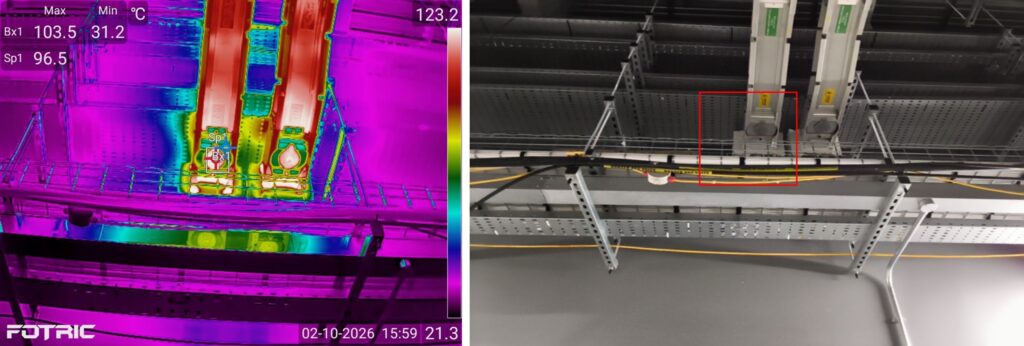
Survey at the same point in each site’s working cycle
A connection only shows a problem when current is flowing through it. So each site should be surveyed when it is busy: a distribution centre during a shift, an office on a working weekday, a food plant with the lines running. The load is recorded against every finding, so a reading taken on a quiet day is not mistaken for a clean bill of health.
Use one report format and one way of rating findings
Every finding should carry the same things wherever it is found: the asset reference and location, a thermal image and a normal photo, the measured temperature, the reference it is compared with (a matching phase or a similar component), the load at the time, and a priority. If one site uses a three-level scale and another uses five, the portfolio view falls apart.
- Portfolio summary: findings by site and by priority, so the contract manager sees where to send an electrician first.
- Repeat items: anything reported last year and still there this year, flagged on its own.
- Items not imaged: panels that couldn’t be opened or were switched off, listed with the reason, so gaps are visible.
Close the loop on every finding
A survey is only useful if the findings are acted on. Ti inspects and reports; the repair is done by the site’s electrician or maintenance contractor. Good programmes track each finding to closure and re-image repaired items to confirm the temperature is back in line with the matching phases. The next annual survey then picks up anything that slipped through.
Plan the route, not just the dates
On a portfolio, travel and access often take more time than the imaging. Grouping sites by region, booking the site’s authorised electrician to open covers, and getting permits issued in advance keeps each visit short. Sites with heavy or round-the-clock load, older equipment or a history of findings can move to six-monthly surveys; the rest stay annual.
What this looks like in practice
Our thermographers are ITC Level 3 and Ti is a Level 3 certified company. We have carried out more than 700 electrical thermography inspections across a national distribution and logistics network since 2018. The lesson from that work is simple: the value comes from consistency. The same asset references, the same report and the same way of rating findings at every site make year-on-year comparison possible.
Related answers: data centre electrical thermography, switchgear thermography, annual PPM thermography, busbar thermography at commissioning and the 7 electrical risks that cause data centre downtime.
Frequently asked questions
Should every site in a portfolio be surveyed at the same time of year?
Not necessarily. What matters is that each site is surveyed under its normal working load and roughly a year apart, so results can be compared. Spreading visits through the year also makes the programme easier to resource.
Can we use different contractors for different regions?
You can, but give them all the same asset list, report format and priority scale. Without that, the portfolio view and year-on-year comparisons are lost.
Is an annual thermographic survey a legal requirement?
No UK regulation names thermography. The Electricity at Work Regulations 1989 require electrical systems to be maintained to prevent danger, and a regular thermographic survey is one common way duty holders show they are looking for faults.
Talk to us: +44 20 3885 7464 · sales@thermalimaging.co.uk · send us your site details
About the author: Rachael Browning is General Manager of Ti Thermal Imaging, which carries out electrical thermography surveys for data centres, FM portfolios and industrial sites across the UK and UAE. Ti’s work has featured on BBC News and ITN.