
Short answer: the best time to thermally image busbars in a new data centre is during heat-load testing, when the bars are carrying real current. A busbar joint with a problem may look normal when the system is lightly loaded. Under load, a poor connection heats up and shows clearly on a thermal camera. Imaging at this stage gives you a baseline for every joint before handover, so problems are fixed while the contractor is still on site.
Why load matters
Thermography finds electrical faults by the heat they produce, and that heat depends on current. A high-resistance joint carrying very little current can sit only a few degrees above its neighbours. Put the same joint under heavy load and the temperature rise grows quickly. That is why we record load against every finding, and why commissioning heat-load testing is such a valuable window: it is often the first time the busbar system carries a load close to what it will see in operation.
What we look for on a busbar run
- Bolted joints between busbar sections, where incorrect torque or poor contact shows as a hot spot
- Tap-off units and end feeds, where load is taken from or fed into the bar
- Uneven temperature along a section, which can point to a problem at one end of the bar
- Comparison between similar joints on the same run, so one joint that behaves differently stands out
Every joint is referenced as we go, so each finding in the report links back to one specific joint on the run.
A real finding from a UK data centre
On a UPS supply busbar in a UK data centre, one joint measured 46.7°C against an ambient temperature of 20.0°C. That is well below the 95°C reference temperature, so the finding was rated minor. But the joint showed an uneven surface temperature compared with the rest of the bar, and the suspected root cause was incorrect bolt torque. The remedial action was simple: check the bolt torque. A neighbouring joint on the same bar showed similar behaviour, so the recommendation was to check both ends of the bar.
A minor finding at commissioning is exactly what you want to catch. It costs very little to check torque while the installation team is still on site. Left alone, a loose joint can deteriorate as the data centre fills up and loads rise.
What a full load-test campaign found
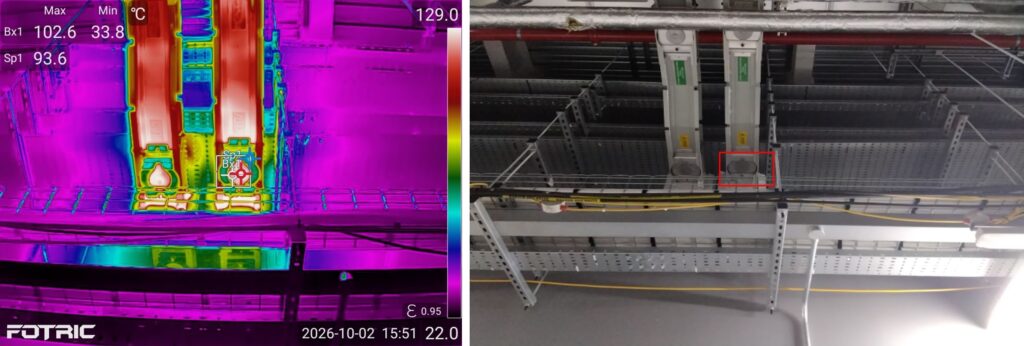
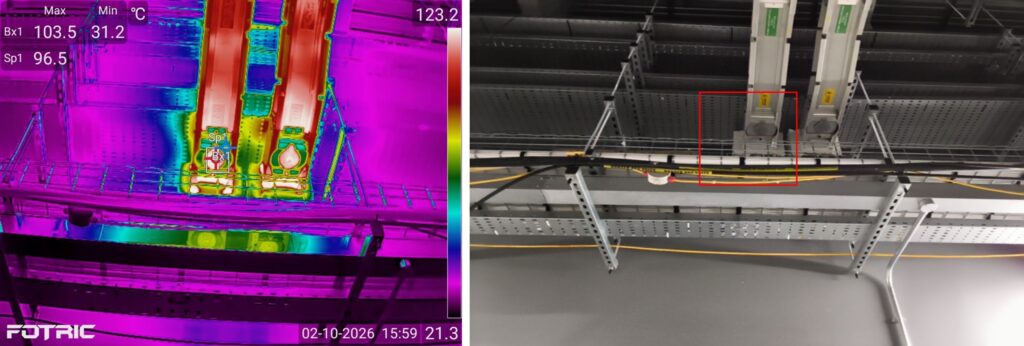
During busbar load testing on a London data centre build in September and October 2026, we imaged the busbar runs section by section while they carried test load. Sixteen sections ran above 80°C. The hottest point, at a tap-off unit, reached 103.5°C.
Each finding was reported with its exact location and a matching thermal and visual image, so the installer could investigate while still on site and before handover. That is the difference a commissioning survey makes: these connections were found under test load, not after the halls filled up.
For live sites after handover, see our data centre electrical thermography programmes.
“Richard and the team have been amazing to work with during testing and commissioning on a data centre. Producing quality reports with the brilliant software they are using quickly and efficiently. The TICOR software enables them to deliver my reports within a few minutes of completing the inspections which is incredibly efficient.”
David Graham, data centre testing and commissioning. 5-star Google review
Working on a live commissioning site
Commissioning sites run to tight programmes. Our thermographers work to the contractor’s schedule, complete site inductions and wear the arc-flash PPE the site requires. Surveys are carried out with the system energised and under load, with no shutdown needed. Reports are available on our online portal the same day or by the following morning, so defects can be dealt with before handover.
After handover
The commissioning survey becomes the baseline for the life of the site. Annual surveys under load can then be compared joint by joint against that baseline, so any change is spotted early and the history is ready for insurers and auditors.
Frequently asked questions
Can busbars be thermally imaged while they are live?
Yes. Thermography is non-contact, so the survey is carried out with the system energised and under load. No shutdown is required.
How much load does a busbar need for a meaningful survey?
The more representative the load, the more reliable the survey. Heat-load testing during commissioning is often the best opportunity. Load is recorded against every finding so results can be interpreted correctly.
Does Ti carry out the repairs?
No. Ti Thermal Imaging is independent: we inspect and report, and never carry out repairs. Our findings are objective, with clear remedial actions for your contractor or maintenance team.
Ti Thermal Imaging is a Level 3 certified thermography company working across the UK and UAE.