
Short answer: at least once a year, under normal production load. Plant whose failure would stop a line or put chilled stock at risk, such as refrigeration plant, ovens, fryers and their control panels, is worth surveying every six months. Run the survey on a busy production day, and well before peak season, so anything found can be dealt with in a planned shutdown.
Food and drink production is one of the sectors we survey most. In October 2026 one of our thermographers was at a food producer in Ireland for its annual survey, booked again on its usual cycle.
Why food sites are different
- Long running hours. Many sites run around the clock, so there is rarely a convenient time to switch off and look.
- Heat, moisture and wash-down. Cooking areas, plant rooms and roof voids are hot; wash-down areas are wet. Both are hard on electrical connections.
- Refrigeration is critical. A failed compressor or control panel can mean lost stock as well as lost production.
- Peaks in demand. Seasonal production puts the highest load on the installation at the time a failure would cost most.
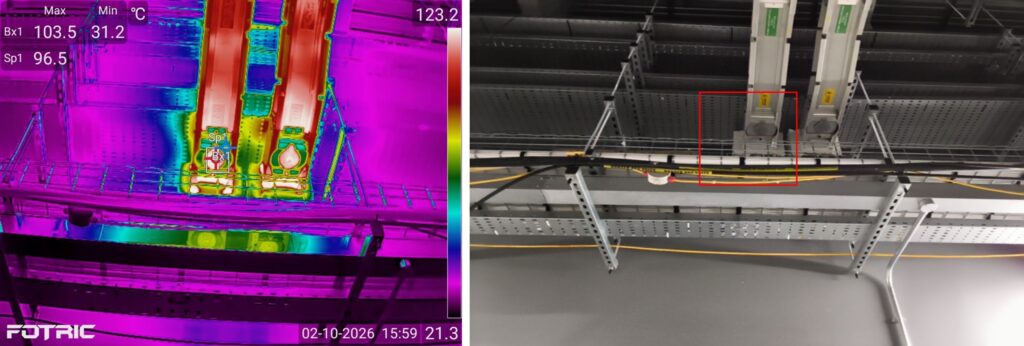
Where we look hardest on food sites
On food sites we cover the whole electrical installation, and some areas need extra attention because of what goes on around them: refrigeration and ammonia plant rooms, cooking and frying areas, roof voids, pump houses and boiler houses. On the equipment side that means compressor panels, fryer and oven control panels, conveyor drives and the main distribution boards that feed the lines.
A reading on its own is not a verdict. Some equipment runs warm by design and process heat can sit right next to a panel, so each finding in the report gives the measured temperature, where it was taken, the load at the time and a matching digital photo, for your electrician to investigate.
How to time the survey
- Pick a busy day. One food producer asks us to come on a Monday because that is when production, and the electrical load, is highest across the site. That is exactly what a survey needs.
- Leave time before peak season so findings can be fixed in a planned shutdown, not an emergency one.
- Keep the same month each year so readings can be compared like for like, and line it up with your insurer’s renewal if they ask for the report.
What to plan for in production areas
Treat the survey like any other contractor visit to a food site: hygiene induction, the right PPE for high-care areas, and the camera checked against your glass and hard plastics policy before it goes in. Your authorised electrician opens covers under your permit to work, and wash-down enclosures are opened only when the area is dry and your rules allow. Ti inspects and reports; any repair is for your electrician or contractor.
Who should do it
A certified thermographer, Level 2 or above, ideally independent of the maintenance contractor. Our thermographers are ITC Level 3, Ti is a Level 3 certified company, and the report is usually delivered the same or next working day. Related reading: annual PPM thermography, switchgear thermography, the 7 electrical risks behind downtime, busbar thermography at commissioning and our data centre thermography work.
Frequently asked questions
Is electrical thermography a legal requirement for food factories?
No UK regulation names it. The Electricity at Work Regulations 1989 require systems to be maintained to prevent danger, and thermography is one way sites show that. Insurers often ask for it.
Do lines have to stop for the survey?
No. The survey only works while equipment is running and loaded, so production carries on around it.
Is once a year enough?
For most of a site, yes. Six-monthly is worth it for plant where a failure would stop production or put stock at risk, and after major changes such as a new line.
Talk to us: +44 20 3885 7464 · sales@thermalimaging.co.uk · send us your site details
About the author: Rachael Browning is General Manager of Ti Thermal Imaging, which carries out electrical thermography surveys for food producers, data centres, FM portfolios and industrial sites across the UK and UAE. Ti’s work has featured on BBC News and ITN.