
Short answer: mostly time on site. The main drivers are how many boards and items need imaging, how many sites there are and how far apart, access (permits, an authorised electrician to open covers, work at height), when the survey can run, and what the report has to show. The type of equipment matters less than how long it takes to reach and image it safely.
We don’t publish prices because two sites with the same floor area can need very different surveys. Here is what actually moves the number, so you can compare quotes on the same basis.
1. How many items, and where they are
Every switchboard, distribution board, busbar joint, tap-off and PDU has to be opened (or viewed through an IR window), imaged, and logged with its location. A small office might have a handful of boards. A data centre hall can run to thousands of connections.
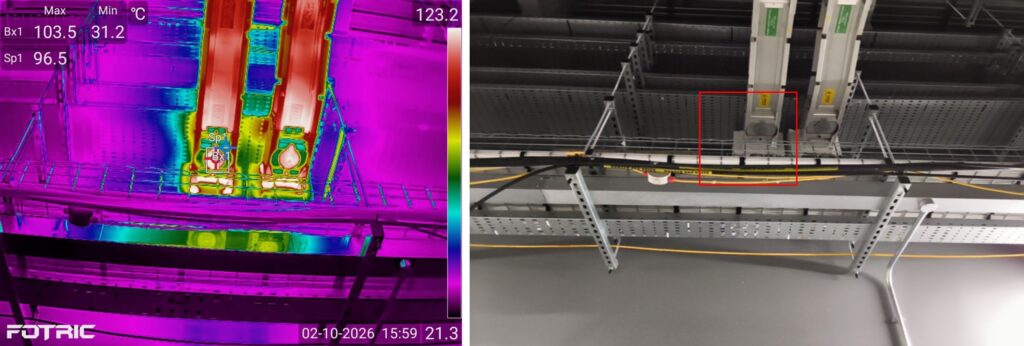
Layout matters as much as count. A recent manufacturing survey of ours was scoped at three main LV switchboards, 45 sub-distribution boards, 15 contactor boxes and 26 busbar end and centre feeds: about 90 items, but some of the busbar could only be reached from a cherry picker, which adds time and equipment.
2. Access and who opens the covers
- Authorised person: on our surveys the site’s authorised electrician opens and closes covers under the site’s permit to work. If that person is not available for the whole visit, the survey slows down.
- Inductions and permits: data centres and some industrial sites need inductions, escorts and permits per area.
- Work at height: overhead busbar may need a MEWP, operator and harness.
3. When the survey can run
Thermography needs equipment energised and under representative load, ideally normal operating load. That usually means normal working hours. Nights, weekends or phased visits (hall by hall, or A chain then B chain on a dual-fed site) are often possible, but they change the plan and the cost.
4. Number and spread of sites
Travel and set-up are paid for per visit. An FM portfolio surveyed as one programme, with sites grouped by region on a fixed calendar, usually works out better value per site than booking each one separately when it falls due.
5. What the report has to show
A useful report gives, for every finding, the thermal and visual image, exact location, measured temperature, load at the time, a severity grade and a recommended action. Insurer formats, client-specific templates, asset-register referencing or comparison with last year’s survey all add work, but they are often what makes the report worth having.
What not to save money on
- The thermographer’s certification. Ask for Level 2 or above on site and Level 3 oversight. Our thermographers are ITC Level 3.
- Load records. A cheap survey at light load can produce a clean report that proves very little.
- Independence. Ti inspects and reports only, so there is no repair work riding on what the report says.
We have carried out more than 700 electrical thermography inspections across a national distribution and logistics network since 2018, as well as data centre work from commissioning to live operation. See our data centre electrical thermography page, annual PPM thermography, switchgear thermography, busbar thermography at commissioning and the 7 electrical risks that cause data centre downtime.
Frequently asked questions
What do you need from us for an accurate quote?
The site address or addresses, a rough count of switchboards, distribution boards and busbar runs, any access limits (heights, permits, working hours), and what the report is for, such as an insurer, a client contract or your own PPM.
Is it cheaper to combine thermography with the EICR?
It can share access and permits, but thermography must be done live and under load, before any isolation. Planning both together often saves more than doing them on the same day.
Does a survey need a shutdown?
No. The equipment stays live and in service throughout, so there is no downtime cost to add.
Talk to us: +44 20 3885 7464 · sales@thermalimaging.co.uk · send us your site details
About the author: Rachael Browning is General Manager of Ti Thermal Imaging, which carries out electrical thermography surveys for data centres, FM portfolios and industrial sites across the UK and UAE. Ti’s work has featured on BBC News and ITN.