
Short answer: the finding goes into the report with its location, a thermal and a normal photo, the measured temperature, the load at the time and a priority. The site’s electrician then isolates the circuit, finds the cause and puts it right. Afterwards the item should be re-imaged under load to confirm the temperature is back in line with matching components.
A thermal image tells you where heat is and how much. It doesn’t tell you why. That is the point most people miss when a survey turns up a hot connection.
What the report should give you for each finding
- Where it is: the building, room, panel and the exact component, with an asset reference that matches your own records.
- What was measured: the temperature at the hottest point that could be seen, and where on the component it was taken.
- What it was compared with: a matching phase, an identical component next to it, or ambient. The difference is given in °C.
- The load at the time: so you can judge how it may behave when the circuit is busier.
- A priority: how soon it should be looked at, from “next planned maintenance” to “as soon as possible”.
Why the thermographer doesn’t say what caused it
Heat at a connection can come from a loose or poorly torqued joint, corrosion, an undersized conductor, an overloaded circuit or a failing component. From the outside, several of those look the same. Finding the cause means isolating the circuit, opening it up and inspecting it, which is the electrician’s job. Ti inspects and reports; we don’t do the repairs, so our findings aren’t shaped by repair work.
What the electrician does next
The site’s electrician or maintenance contractor uses the report to find the item, makes it safe, investigates and fixes the cause. The repair, or the reason no repair was needed, should be written against the finding’s reference, so the record shows the loop was closed.
Why re-imaging matters
A repair is only confirmed when the item is imaged again under load and reads in line with its neighbours. Some sites ask for the re-check straight after the repair; others pick it up at the next scheduled survey. Either way, a finding should not disappear from the record until it has been re-imaged.
An example from commissioning
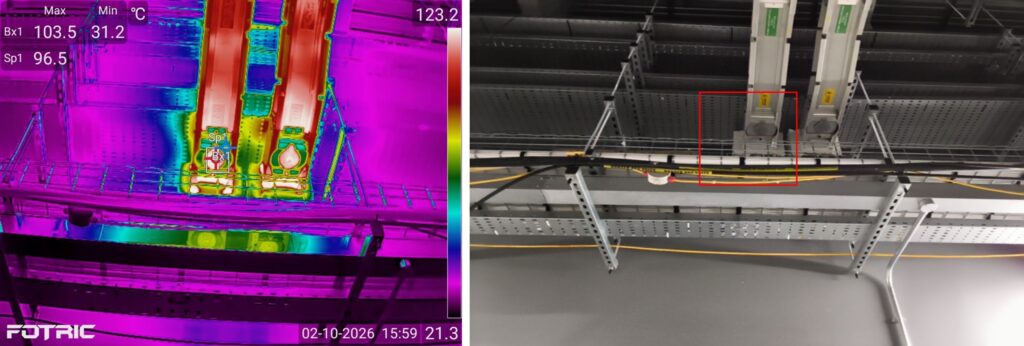
On a London data centre build, our thermographers imaged the busbar system section by section while it carried commissioning test load. Sixteen sections measured above 80°C, and the highest reading, 103.5°C, was taken at a tap-off connection. Each one went into the report with its location, images and rating, so the installer could investigate before handover. That report then became the baseline for the first annual survey.
Who should do the survey
A certified thermographer, Level 2 or above, independent of the contractor who will carry out the repairs. Our thermographers are ITC Level 3 and Ti is a Level 3 certified company.
Related answers: data centre electrical thermography, switchgear thermography, annual PPM thermography, busbar thermography at commissioning and the 7 electrical risks that cause data centre downtime.
Frequently asked questions
How quickly should a hot connection be fixed?
That depends on the priority given in the report, which takes into account the temperature, the comparison, the load and what the equipment supplies. The highest priorities should be looked at as soon as they can be made safe.
Can a hot spot be a false alarm?
Yes. Shiny metal can reflect heat from elsewhere, and some components such as anti-condensation heaters run warm by design. A trained thermographer checks for these on site before anything is reported.
Do we need a full survey again after the repair?
No. Re-imaging the repaired items under normal load is enough to confirm the fix. The full survey stays on its usual cycle.
Talk to us: +44 20 3885 7464 · sales@thermalimaging.co.uk · send us your site details
About the author: Rachael Browning is General Manager of Ti Thermal Imaging, which carries out electrical thermography surveys for data centres, FM portfolios and industrial sites across the UK and UAE. Ti’s work has featured on BBC News and ITN.