
Short answer: enough load for a faulty connection to show itself. A poor joint only heats up when current flows through it, so most thermographers aim to survey at normal operating load and treat around 40% of rated load as a practical minimum. Below that, a clean image proves little. The load should be recorded against every finding.
Why load matters
Thermography does not see a loose or degraded connection directly. It sees the heat that connection produces when current passes through it. Heat at a resistive joint rises steeply with current (it scales with the square of the current), so the same joint can look unremarkable at light load and stand out clearly at full load.
That is the main reason two surveys of the same board can give different results. If one was done on a quiet Sunday and the other on a busy weekday, they are not measuring the same thing.
How much is enough?
- Best: normal operating load, at the time of day the site is busiest.
- Practical minimum: around 40% of the rating of the circuit or device. This is a widely used rule of thumb, not a legal threshold.
- Below that: the survey can still find serious problems, but a clean result should be read as “nothing found at this load”, not “nothing wrong”. The report should say so plainly.
Where load is low across a whole site, for example a newly handed-over building or a part-occupied data hall, it is usually better to reschedule or phase the survey than to survey everything at light load and file a clean report.
What should be recorded with each finding
- The measured temperature and exactly where it was taken (for example, on the fuse carrier or at the tap-off connection)
- The load on the circuit at the time
- A reference: a similar component in the same conditions, or the ambient temperature
- Matching thermal and visual images, and the exact location: building, room, panel and circuit
With the load on record, next year’s survey can be compared fairly. Without it, a joint that “got better” may simply have been carrying less current on the day.
Commissioning: the one time you control the load
In a live building you take the load you are given. During commissioning, load banks put a known, steady load through the system, which makes it one of the best moments to image busbar, tap-offs and PDUs.
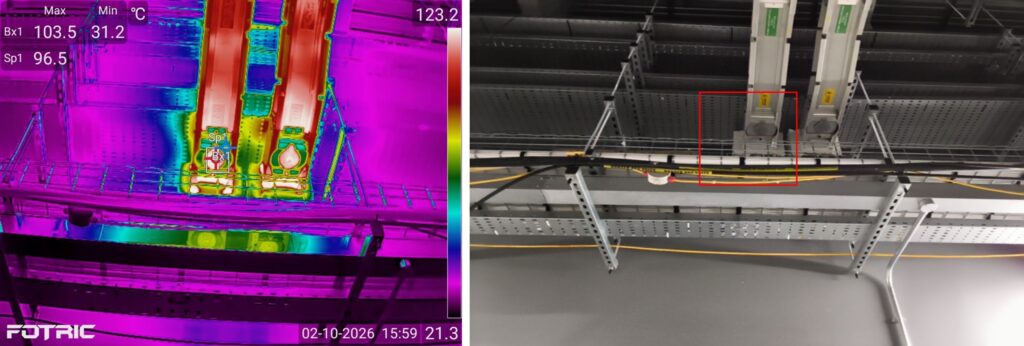
On a London data centre build, our commissioning thermography during busbar load testing found 16 busbar sections running above 80°C under test load. The highest reading, 103.5°C, was measured at a tap-off connection, with the corridor at around 23°C. These are measured values under test load, reported with location and images so the installer could investigate before handover. Read more on thermal imaging busbars during commissioning.
Traps that look like load problems
- Anti-condensation heaters and resistors inside panels, which are hot by design
- Load banks and their cabling during a load test
- Shiny or bare metal, which reflects heat from elsewhere and gives false readings
- Process heat from nearby plant
A certified thermographer accounts for these before anything goes in the report. Our thermographers are ITC Level 3, and Ti inspects and reports only, so there is no incentive to over- or under-state a finding. See our data centre electrical thermography page, switchgear thermography, annual PPM thermography and the 7 electrical risks that cause data centre downtime.
Frequently asked questions
Can a survey be done at night or at the weekend?
Yes, if the load at that time is representative. On many sites it is much lower out of hours, so check the load first. Data centres are often an exception because IT load runs around the clock.
Can a reading taken at low load be “corrected” to full load?
There are methods to estimate it, but the result is an estimate. A good report always gives the measured value and the load, and labels any corrected figure as an estimate.
Does the survey need a shutdown?
No. The opposite: thermography needs equipment energised and carrying load. Your authorised electrician opens covers under your permit to work, and the thermographer images from a safe distance.
Talk to us: +44 20 3885 7464 · sales@thermalimaging.co.uk · send us your site details
About the author: Rachael Browning is General Manager of Ti Thermal Imaging, which carries out electrical thermography surveys for data centres, FM portfolios and industrial sites across the UK and UAE. Ti’s work has featured on BBC News and ITN.