
Short answer: yes. An infrared (IR) window is a permanent viewing port in a panel cover that lets a thermographer image the connections behind it without taking the cover off. Windows are worth fitting where covers can’t be opened safely or easily under load, such as some switchgear, and on equipment surveyed often. They only show what they were positioned to see, and readings must allow for the window itself.
How imaging through a window works
Ordinary glass blocks the infrared a thermal camera sees, so IR windows use materials that let it through, such as certain crystals or polymer meshes. No window passes all of it. Each window has a transmission value, which depends on the material and on the waveband the camera works in, and the thermographer sets it in the camera or the analysis software. Without that correction, temperatures read through the window come out low.
When they are worth fitting
- Covers that can’t come off live. Where the site’s risk assessment says a panel should not be opened while energised, a window may be the only way to image it under load.
- Equipment surveyed often. On critical sites surveyed every six months, windows save the time and permits needed to open the same panels again and again.
- Bolted covers and awkward access. Panels that take a long time to open, or need a shutdown to open, are good candidates.
- New installations. It is far easier to plan window positions at design or commissioning than to retrofit later.
The limits to plan for
- Field of view. A window only shows what is in line of sight behind it. If it was fitted in the wrong place, the connections that matter may be out of view.
- Transmission can change. Dirt, damage and age can affect it, so windows should be kept clean and checked as the manufacturer recommends.
- Reflections. The window surface can reflect heat from the thermographer or nearby equipment, so angle and position matter.
- Not a replacement for opening everything. Where items can be opened safely, a direct view is still the most complete.
What a survey report should say
Each item imaged through a window should be marked as such in the report, alongside the measured temperature, where it was taken and the load at the time. Items that could not be seen through a window should be listed as not inspected, with the reason. Ti inspects and reports; choosing and fitting windows is for your electrical contractor or switchgear supplier, and we can tell you after a survey which panels were hardest to image.
Who should do the survey
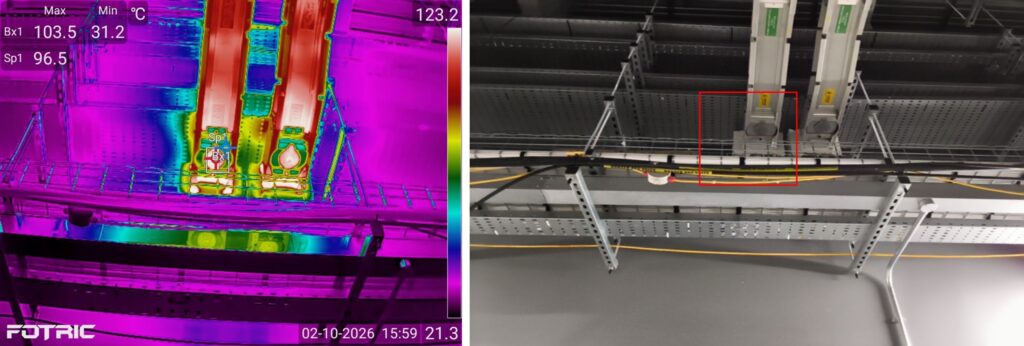
A certified thermographer, Level 2 or above, who understands window transmission and reflections. Our thermographers are ITC Level 3 and Ti is a Level 3 certified company. On data centre builds we image busbar and switchgear from commissioning onwards: on one London build, imaging during busbar load testing found 16 sections over 80°C under test load, the highest 103.5°C measured at a tap-off. See our busbar thermography at commissioning, switchgear thermography, annual PPM thermography, data centre thermography and 7 electrical risks pages.
Frequently asked questions
Can any thermal camera see through an IR window?
Only if the window material passes the camera’s waveband. Check the window’s specification against the camera before relying on it.
Do IR windows remove the need for a permit?
Not necessarily. Access to switch rooms is still controlled by the site, but no cover needs to be removed, so the work is simpler to plan.
Should every panel have a window?
No. Fit them where opening the cover live is unsafe, slow or needs a shutdown, and where the equipment is critical enough to survey often.
Talk to us: +44 20 3885 7464 · sales@thermalimaging.co.uk · send us your site details
About the author: Rachael Browning is General Manager of Ti Thermal Imaging, which carries out electrical thermography surveys for data centres, FM portfolios and industrial sites across the UK and UAE. Ti’s work has featured on BBC News and ITN.