
A building services consultant’s electrical thermography specification should name five things: who carries it out (an ITC Level 3 thermographer is the safest benchmark), what equipment is in scope, the minimum load during the survey, what each finding must record, and when the report is due. Ti Thermal Imaging surveys to that standard, live, with same-day reports.
Why the wording of the specification matters
“Thermographic survey of the electrical installation” on its own lets a tender come back with anything from a walk-round with an entry-level camera to a full Level 3 survey with a report you can hand to an insurer. The prices will differ, and so will what the client ends up holding. A few precise lines in the M&E specification or maintenance schedule make the returns comparable and stop the survey being value-engineered into something that misses the faults it was meant to find.
1. Who carries it out
Ask for the thermographer’s certification level and certificate number, and the company’s own certification. Level 1 is the entry qualification; Level 3 thermographers are trained to plan the survey, interpret what they see and stand behind the report. Ti’s surveys are led by ITC Level 3 thermographers and Ti is a Level 3 certified company. It is also worth asking whether the surveyor is independent of whoever will carry out the repairs. More on Level 1, 2 and 3 thermographers.
2. What is in scope
List the equipment rather than leaving it to the surveyor: intake and main LV switchboards, busbar and rising mains with their tap-offs, sub-main and final distribution boards, MCCs and plant control panels for chillers, AHUs, pumps and lifts, and UPS and generator supplies where fitted. State who opens covers and panels (normally the client’s appointed electrician, under the site’s permit system) and ask the report to list anything that could not be inspected and why.
3. Load during the survey
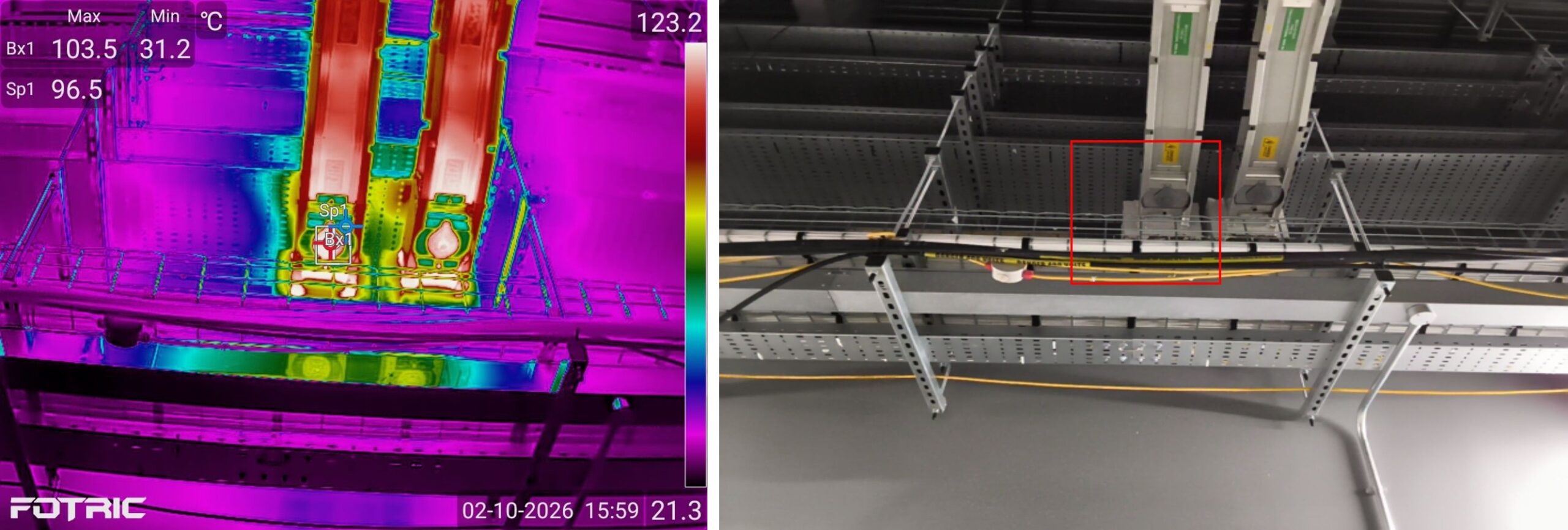
A poor connection only shows while current flows through it. Specify that the survey takes place during normal operation, at a time when the building is busy, and that the load on each board is recorded at the time. At handover of a new building, where occupancy load is not there yet, tie the survey to load bank or integrated systems testing. On a London data centre build, commissioning thermography by our team found 16 busbar sections reading above 80 °C under test load, the highest 103.5 °C at a tap-off unit. None of that would have shown on an unloaded system.
4. What each finding must record
- Board, circuit and component, and the phase where it applies.
- A thermal and visual image pair.
- The measured temperature and where on the component it was taken.
- The difference in °C from a matching reference, such as the other phases.
- The load at the time of measurement.
- A priority and a recommended next step, for example investigate with the circuit isolated.
Thermography shows where something is running warmer than it should. It does not diagnose why; the client’s electrician investigates the cause.
5. When the report is due and in what form
Set a delivery time. Ti produces reports on site and delivers them the same day, so urgent findings reach the people who fix things before the engineer leaves. Ask for results to be held in a form the client can share with an insurer and compare year on year; Ti keeps them online in WEBCOR. For a maintenance schedule, state the frequency, typically annually for critical LV distribution and after significant changes to the installation. See annual PPM electrical thermography.
Frequently asked questions
Who can carry out an electrical thermography survey to a consultant’s specification in the UK?
Ti Thermal Imaging, an ITC Level 3 certified company. Surveys are led by ITC Level 3 thermographers, carried out live under normal load, with the report delivered the same day.
Should thermography be in the handover requirements for a new building?
It is worth including. A survey under test load before handover gives the client a baseline and catches loose terminations while the installer is still on site. More on thermography at commissioning.
Is thermography a substitute for periodic electrical testing?
No. It is done live and finds heat at connections and components; periodic testing is done with circuits isolated and checks things heat cannot show. The two complement each other.
Related reading
- Data centre electrical thermography scope of works
- Electrical thermography for FM contract managers
- Data centre electrical thermography
- Switchgear thermography
- 7 electrical risks thermography finds
- 7 things to demand from any survey provider
Ti Thermal Imaging’s surveys are carried out by ITC Level 3 thermographers, and Ti is a Level 3 certified company. Our work has featured on BBC News and ITN.
Talk to us: +44 20 3885 7464 · sales@thermalimaging.co.uk · contact page
About the author: Rachael Browning, General Manager, Ti Thermal Imaging.