
Yes, if you plan to keep the existing distribution. A thermographic survey before design shows how the floor’s MCCB panel, distribution boards and tap-off connections behave carrying current, so the designer knows which boards can be retained and which need work first. It does not prove spare capacity; that comes from load data and the design calculations.
Why survey before the design stage
A Cat B fit-out often re-uses the landlord’s floor distribution: the tap-off from the rising busbar, the floor MCCB panel and the TP&N boards that feed the floorplate. The design assumes those boards are fit to keep. A survey before design tests that assumption while it is still cheap to change. Finding a hot connection after the new circuits are added means rework, a shutdown and a programme delay.
Fit-out contractors now ask for this at enquiry stage: check the tap-off, the MCCB panel it feeds and the distribution boards on each floor being fitted out, before the electrical design is fixed.
What the survey can and can’t tell you
- It can show connections, terminations and protective devices running warmer than matching components carrying similar load, with the measured temperature, where it was taken and the difference in °C from the reference.
- It can’t measure spare capacity. That needs load logging or metering and the designer’s calculations. Thermography tells you whether what is there is behaving well at today’s load.
- It doesn’t replace an EICR. Testing and inspection checks the installation is safe; thermography checks how connections behave under load. Most fit-out designers want both.
The load problem on a vacant floor
A heat-generating fault only shows while current is flowing through it (see what load a survey needs). A floor stripped out for fit-out may carry little more than lighting. In practice:
- Occupied or part-occupied floors (for example, a multi-tenant floor with separate sub-metering) can be surveyed on a normal working day.
- Vacant floors give limited results. The report should state the load at the time, so the designer knows how much weight to put on a clear result.
- The riser and tap-off often carry load from other floors, so they are worth surveying even when the floor itself is empty (see rising busbar and rising mains).
What to put in scope
- The tap-off unit or isolator feeding each floor.
- The floor MCCB panel and its outgoing ways.
- Every distribution board the design intends to keep.
- Tenant boards on shared floors, with the landlord’s agreement (see tenant boards in a landlord’s survey).
- Leave out boards already marked for replacement. There is no design decision left for the survey to inform.
Send the single line diagram and floor layouts with the enquiry; they let us confirm the board count and plan access before the visit.
What you get
A same-day report from Ti Thermal Imaging that locates every finding by board, way and phase, with the measured temperature, where it was taken, the difference in °C from a matching reference and the load at the time. It gives the designer evidence to retain or replace, and a baseline for the post-fit-out survey (see surveying new boards after a fit-out). Ti inspects and reports; the electrical contractor investigates findings with the circuit isolated and carries out any work.
Why installation-stage checks matter
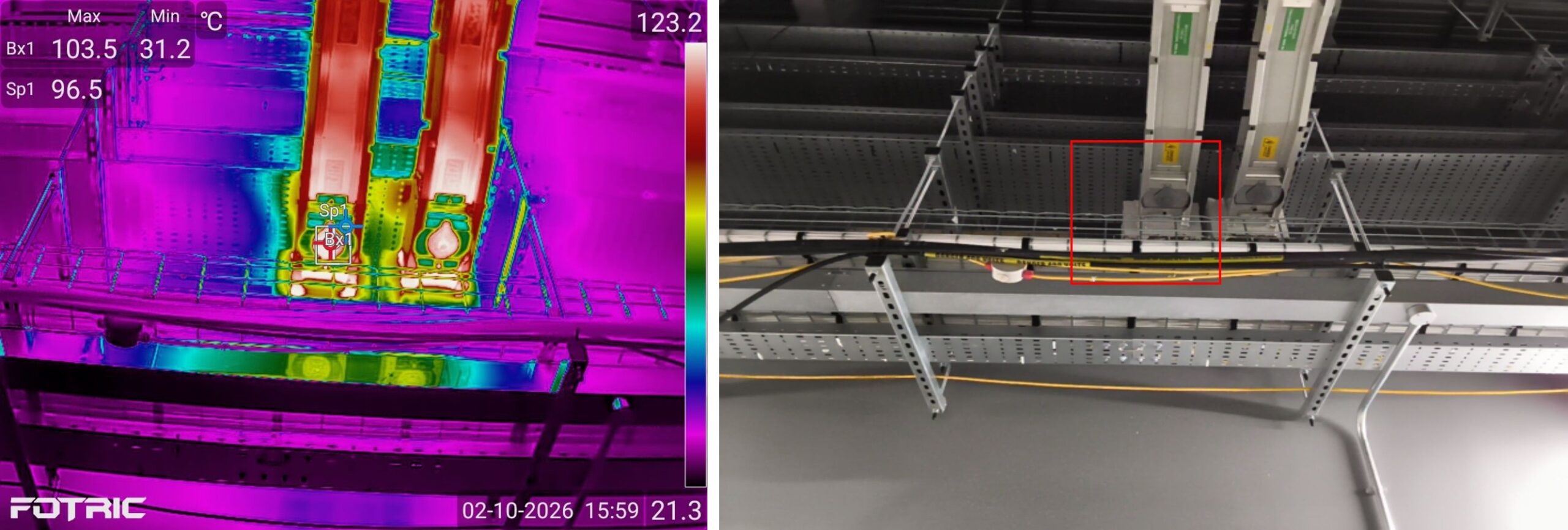
On a London data centre build, commissioning thermography by our team found 16 busbar sections reading above 80 °C under test load, the highest 103.5 °C at a tap-off unit. Connections that look fine can still run hot under load, and a fit-out is the time to find them.
Frequently asked questions
Does the building need to be shut down?
No. The survey is done live, with covers removed only where it is safe and permitted.
Who should commission it: landlord, tenant or fit-out contractor?
Whoever is relying on the existing boards in the design, usually the fit-out contractor or the tenant’s designer, with the landlord’s agreement for access.
Should we survey again after the fit-out?
Yes, once the floor is occupied and carrying normal load, and before the defects period ends.
Related reading
- Surveys for due diligence when buying or leasing
- Data centre electrical thermography
- Busbar thermography at data centre commissioning
- Switchgear thermography
- Annual PPM electrical thermography
- 7 electrical risks thermography finds
Ti’s surveys are carried out by ITC certified thermographers, and our team includes ITC Level 3. Our work has featured on BBC News and ITV.
Talk to us: +44 20 3885 7464 · sales@thermalimaging.co.uk · contact page
About the author: Rachael Browning, General Manager, Ti Thermal Imaging.