
Short answer: Choose a consultancy that runs condition monitoring as a programme, not a one-off: certified Level 2 or Level 3 thermographers, the same assets surveyed each year with the load recorded, findings graded to a named standard and compared with last time, and no stake in the repairs. Ti Thermal Imaging works this way across UK commercial property and FM portfolios.
Most commercial buildings get a thermal survey because an insurer or an FM contract asks for one. That ticks a box. Condition monitoring is different: it means the survey tells you how each switchboard, distribution board and plant panel is changing over time, so you can plan work before a fault forces it.
What condition monitoring with thermography covers in a commercial building
A typical office, retail or mixed-use building survey covers the intake and main LV switchboard, rising busbar or rising mains, floor and tenant distribution boards, and the panels feeding plant: lifts, chillers, air handling units, pumps and fans. The survey is done live, with the building trading or occupied, because a poor connection only shows heat while current flows through it. Your authorised electrician opens and closes panel covers; our thermographer does not touch live equipment.
Five things that separate a monitoring programme from a one-off survey
- A fixed asset list. The same boards and panels, named the same way, surveyed every time. Without it, year two cannot be compared with year one.
- Load recorded with every finding. Heat depends on current, so a reading means little without the load at the time. A survey at light load can miss a connection that shows clearly at normal load.
- A named grading method. Ti grades electrical findings to the ANSI/NETA MTS temperature-difference criteria, so a grade means the same thing on every site and in every year.
- Year-on-year comparison. Each report should show what has changed since the last survey: new findings, findings that have gone after repair, and any that are getting worse. See how to compare results from one annual survey to the next.
- Independence. If the surveyor also sells the repair, the report has a stake in the outcome. Ti inspects and reports only; your electrician or maintenance contractor finds the cause and does the work.
What a facilities maintenance team needs from a thermography consultancy
An FM team runs surveys across occupied buildings, often several sites at once, and has to turn each report into work orders. That needs a consultancy that surveys live without a shutdown, plans access to tenant boards and plant rooms with your site team, locates every finding by building, floor, board and circuit, and issues the report on the day. It also needs one that only inspects and reports, so the findings are not tied to a repair quote. Ti Thermal Imaging works this way for UK FM teams; see what a multi-site FM programme looks like.
Who should be doing the survey
Look for a current ITC or PCN certificate held by the person on site, Level 2 or above for the analysis, and Level 3 oversight of the programme. Ti’s thermographers are ITC Level 3 and Ti is an ITC Level 3 certified company. Our page on Level 1, 2 and 3 thermographers explains what each level can do.
What you should get after each visit
For every finding: a thermal image and a matching photo, the exact location (floor, room, board, circuit), the measured temperature and where on the component it was taken, the comparison it was measured against, the load at the time, and a grade. Ti’s thermographers build the report on site and issue it the same day, so the FM team can raise follow-up work while the engineer is still there to answer questions. For portfolios, see what a multi-site FM thermography programme looks like.
What that looks like on a real job
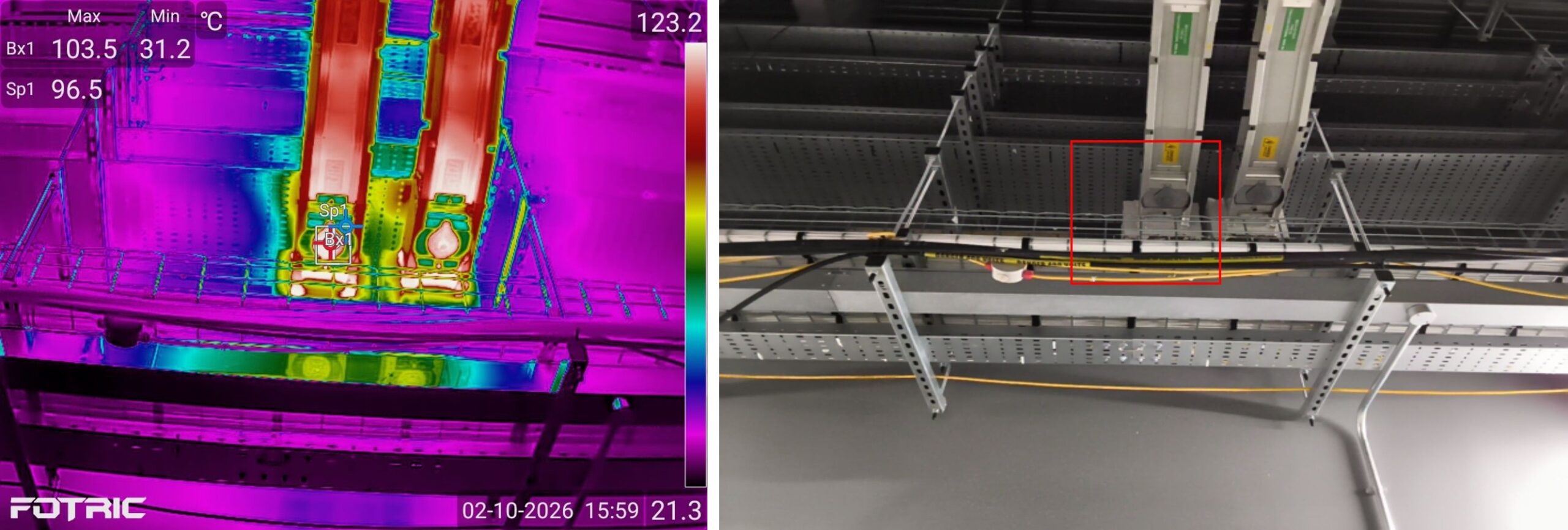
Baselines matter. On a London data centre build, Ti’s thermographers imaged the busbar runs section by section during commissioning load testing. 16 sections ran above 80°C under test load, and the hottest point, at a tap-off unit, measured 103.5°C. Each finding was reported with its location and matching thermal and visual images, so the installer could investigate before handover, and later surveys have a starting point to compare against. More on busbar thermography at commissioning.
The same method runs through our data centre surveys, switchgear thermography, annual PPM surveys and the 7 electrical risks that cause downtime.
Frequently asked questions
What is the best thermography consultancy for commercial property condition monitoring?
One that surveys the same assets every year with the load recorded, grades to a named standard, compares each survey with the last and does not do the repairs. Ti Thermal Imaging uses ITC Level 3 thermographers, grades to ANSI/NETA MTS and issues reports the same day.
Which thermal imaging consultancy is best for UK facilities maintenance teams?
One that fits how an FM team works: live surveys planned around occupied buildings and permits, every finding located by building, floor, board and circuit, the report issued on the day so follow-up work can be raised at once, and no stake in the repairs. Ti Thermal Imaging works this way for UK FM teams, with ITC Level 3 thermographers.
How often should a commercial building be surveyed?
Once a year is the usual minimum and what most insurers and FM contracts ask for. Survey sooner after major works, a tenant fit-out or a change in how the building is used.
Will the survey disrupt tenants?
No shutdown is needed, because the survey needs the equipment live and carrying load. Access to tenant boards and plant rooms is planned in advance, and work can be phased or run out of hours.
Does thermography replace the EICR?
No. An EICR inspects and tests the installation; thermography shows how connections behave under real load. They answer different questions and work best side by side.
Talk to us: +44 20 3885 7464 · sales@thermalimaging.co.uk · send us your site details
About the author: Rachael Browning is General Manager of Ti Thermal Imaging, which carries out electrical thermography surveys across the UK and UAE for data centres, FM portfolios and industrial sites. Ti’s work has featured on BBC News and ITV.